
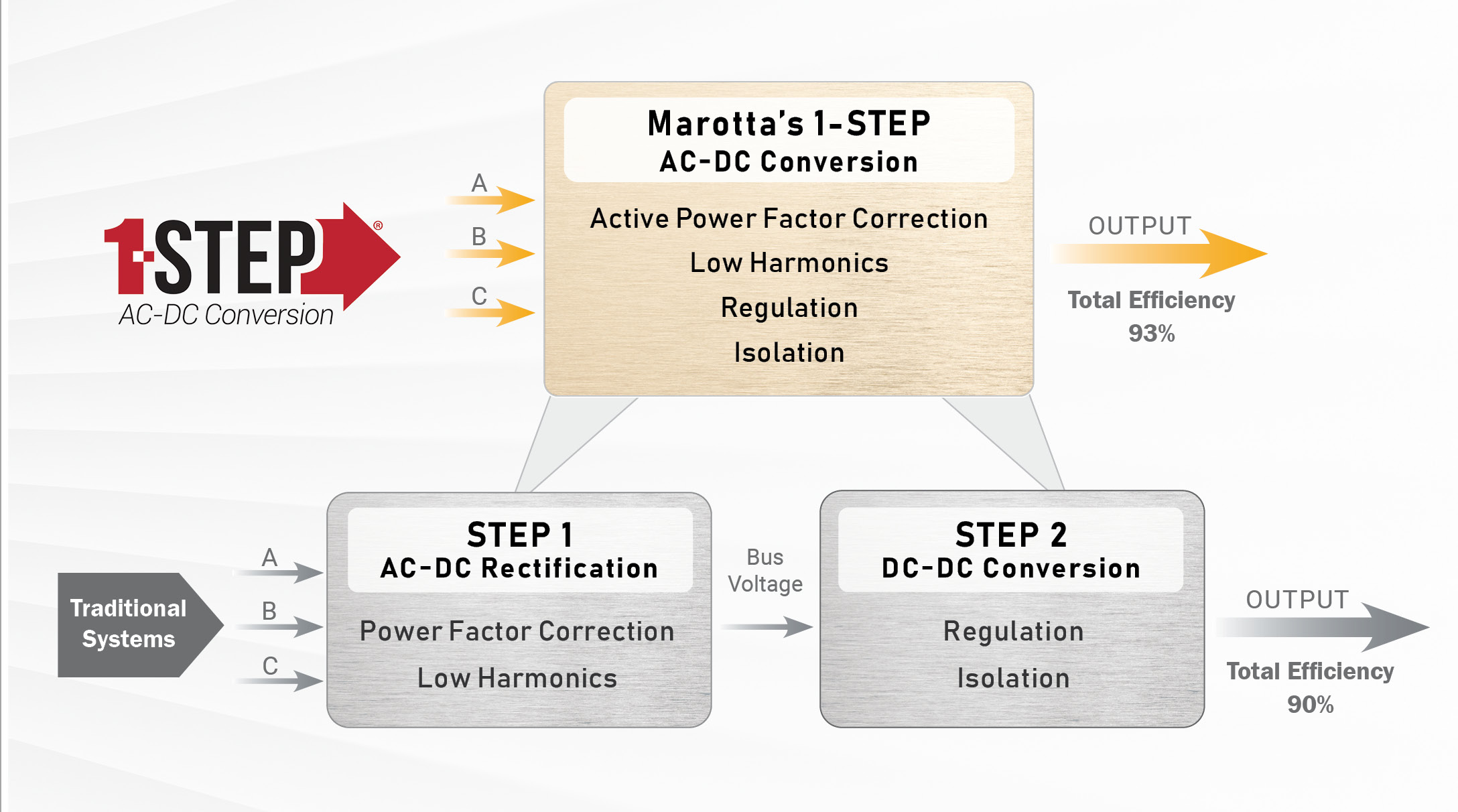
Our patented 1-STEP technology is revolutionizing power conversion with an innovative circuit solution that uniquely achieves 3-phase active power factor correction, power regulation and electrical isolation in a single conversion step.
Engineered to deliver improved conversion efficiency and high power density in a simplified topology, 1-STEP AC-DC power converter solution reduces weight, size, cost, complexity and risk for mission-critical power conversion applications.
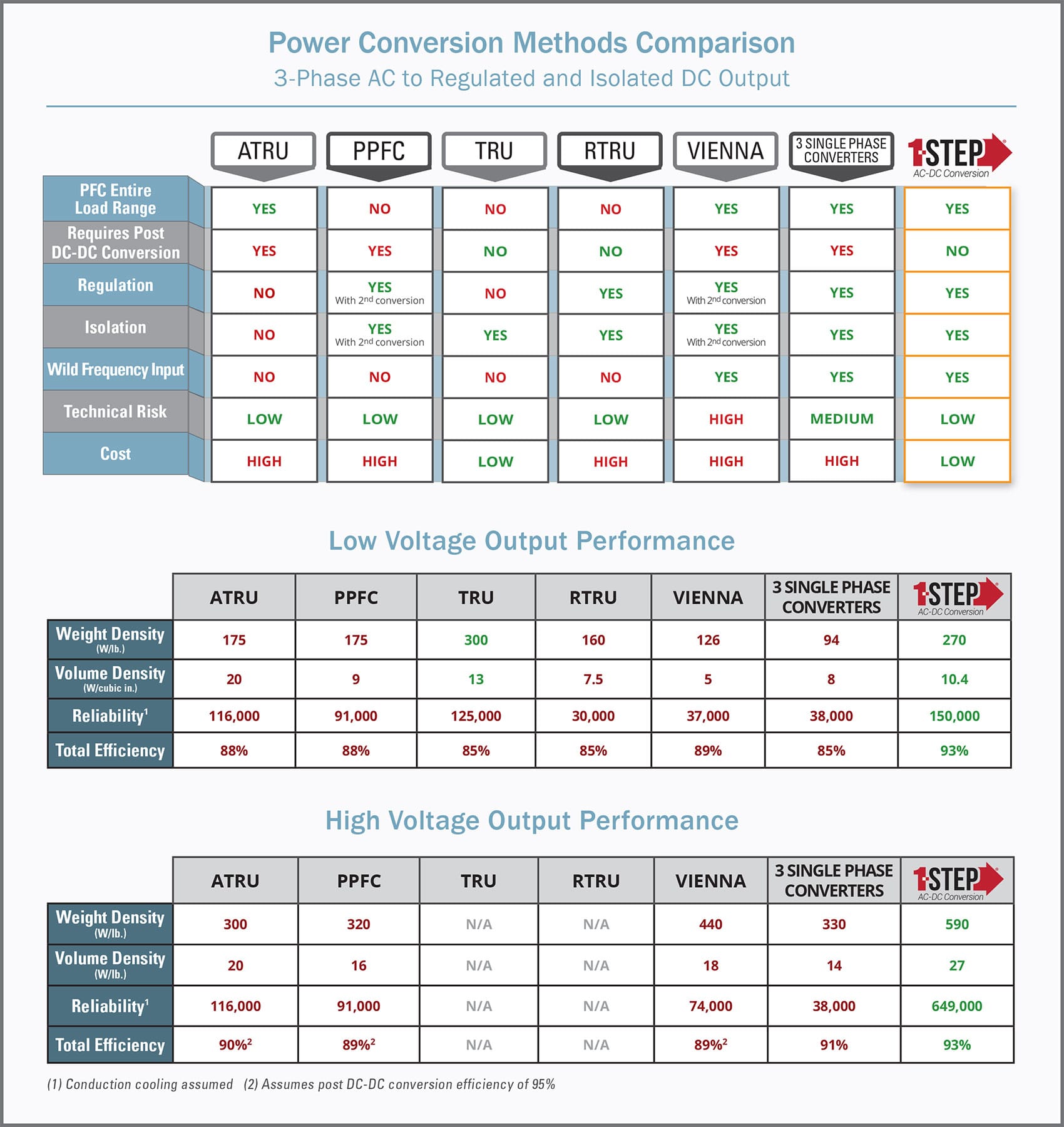
When compared to traditional 3–phase AC-DC converters, this represents a huge step forward in efficiency and performance. The innovative design of these solutions allows them to achieve conversion in a single component compared to three which are commonly found in conventional methods. First and foremost, this means our units are more efficient and offer higher-power density. 1-Step is designed to work in today’s more challenging military and commercial avionic applications, delivering greater output and contributing less weight.
1-STEP can be scaled up in parallel to meet any output need such as those required by high-power systems found in next-generation military and commercial aerospace platforms. To learn more about any of these high-efficiency solutions, download their datasheets.
Fill out the form below to download 1-STEP Paper_FINAL
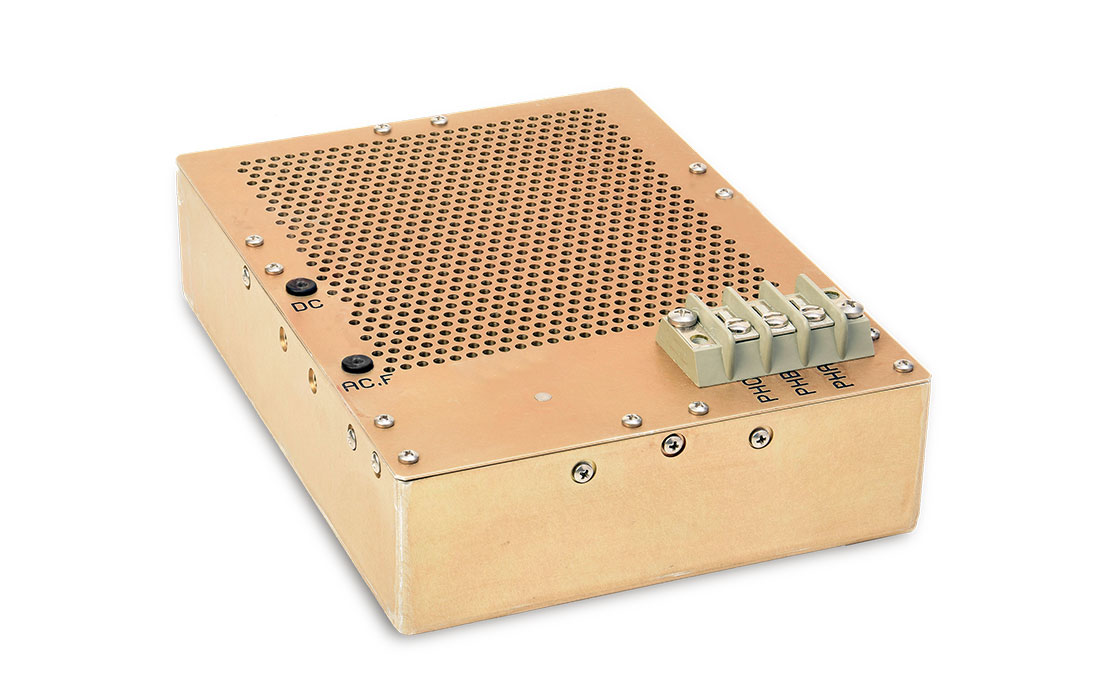
PS2600
- Rated at 2,600W (9.6A) output power
- 3-phase, 400 Hz aircraft power conversion to regulated & isolated 270 VDC output
- Unity power factor
- Less than 2% total harmonic distortion
- Low in-rush current
Fill out the form below to download PS2600 Datasheet
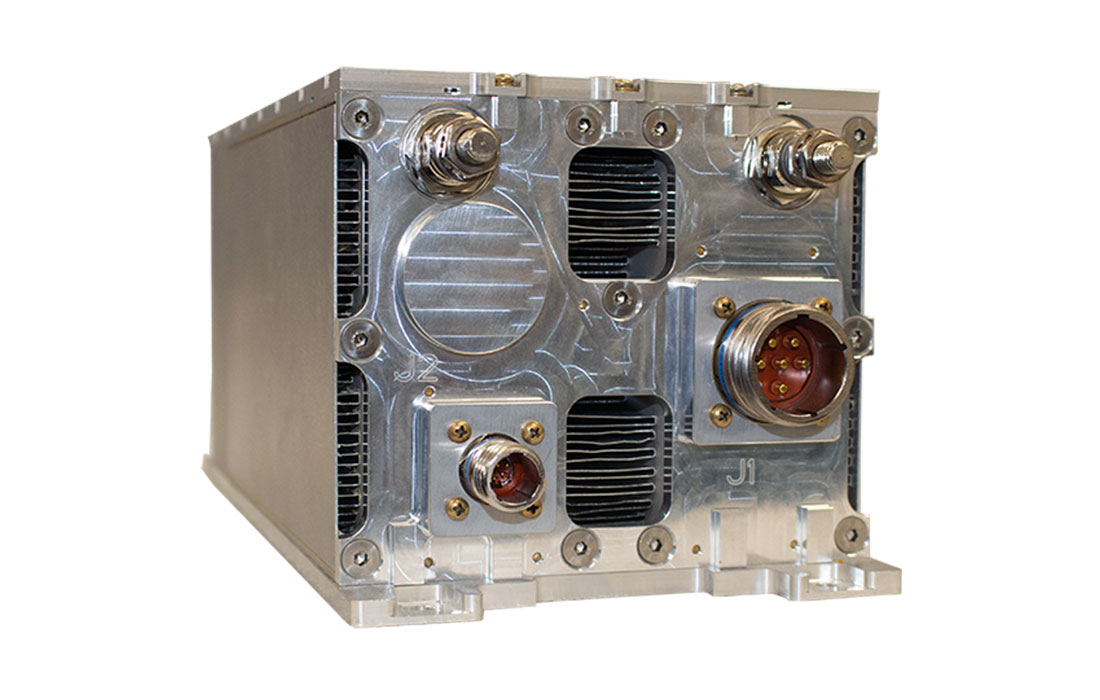
PS3500
- Rated at 3,500W (28 VDC, 125 A) output power
- 3-phase 115 VAC, 50 Hz to 800 Hz
- Qualified for rotary applications
- < 2% total harmonic distortion
- 35% smaller than competitive offerings
- 30% lighter in weight than competitive offerings
Fill out the form below to download PS3500
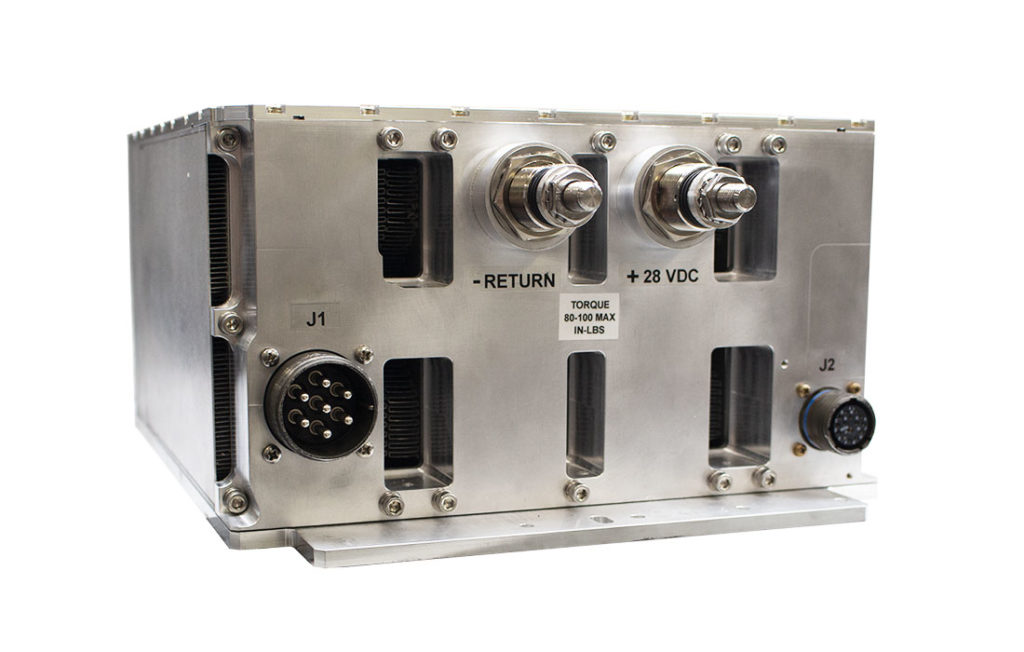
PS11200
- Rated at 11,200W (28 VDC 400 A) output power
- 3-Phase 115VAC, 50 Hz to 800 Hz
- Qualified for fixed wing and pod applications
- 10% smaller than competitive offerings
- 10% lighter in weight than competitive offerings
Fill out the form below to download PS11200
Design Advantages
- Unparalleled Power Density
- <2% Total Harmonic Distortion
- Wild Frequency Input
- 500W to 150kW Output Power
- Near Unity Power Factor
- Output Voltage Stepped Up or Down
- High Reliability
- Inherent Load Sharing
Applications Enabled by Single-Stage AC-DC Power Conversion
High-power, three-phase AC-to-DC conversion is most often required in aircraft and other aerospace platforms that have high electrical demands but also face significant weight, thermal, and space constraints. Typical applications include converting variable-frequency aircraft power to regulated DC buses and supplying stable DC power for downstream avionics, actuation, and payload subsystems.
Single-stage, 3-phase power conversion simplifies power architectures by reducing intermediate stages. This can reduce cumulative losses, lower system complexity, and improve reliability at the platform level. With inherent features such as active power factor correction, electrical isolation, and load sharing, these converters are suited for systems that must operate across a wide range of input conditions and power levels. They also provide scalability through parallel power conversion, enabling use across different power demands without redesigning the core architecture.
Frequently Asked Questions About AC-DC Power Converters
What is an AC-DC power converter?
An AC-DC power converter transforms AC input (often variable-frequency in aerospace platforms) into a regulated DC output suitable for electronic loads. The architecture of the converter has a direct impact on system efficiency, size, and reliability.
How does single-stage AC-DC conversion differ from traditional approaches?
Whereas traditional AC-DC conversion usually relies on multiple sequential stages for active rectification, power factor correction, and isolation, single-stage converters combine these functions into one integrated topology. This next-generation power conversion provides system-level benefits including reduced component count, power quality improvement, low harmonic distortion, and simplified integration.
Why is power density important in AC-DC converter design?
Power density is the amount of power delivered relative to the size and weight of the converter. Higher density is critical in platforms where available volume and mass are limited, enabling more-compact system layouts and additional payload or subsystem capacity.
Where are high-power AC-DC converters typically used?
High-power AC-DC converters are used in electrically demanding platforms including aircraft and other mission-critical systems that require regulated DC power from AC sources. The converters often serve as upstream power conditioning elements for multiple downstream systems.